
 BreachModal
- Published
- Under
- Threat Intelligence
- Reference
- CVE-2026-35616
- Reading time
- 4 min
FortiClient EMS Zero-Day RCE: CVE-2026-35616 Analysis
Summary
Active zero-day exploitation of FortiClient EMS (CVE-2026-35616) bypasses authentication to drop EKZ Infostealer. Analysis, IoCs, and mitigation.
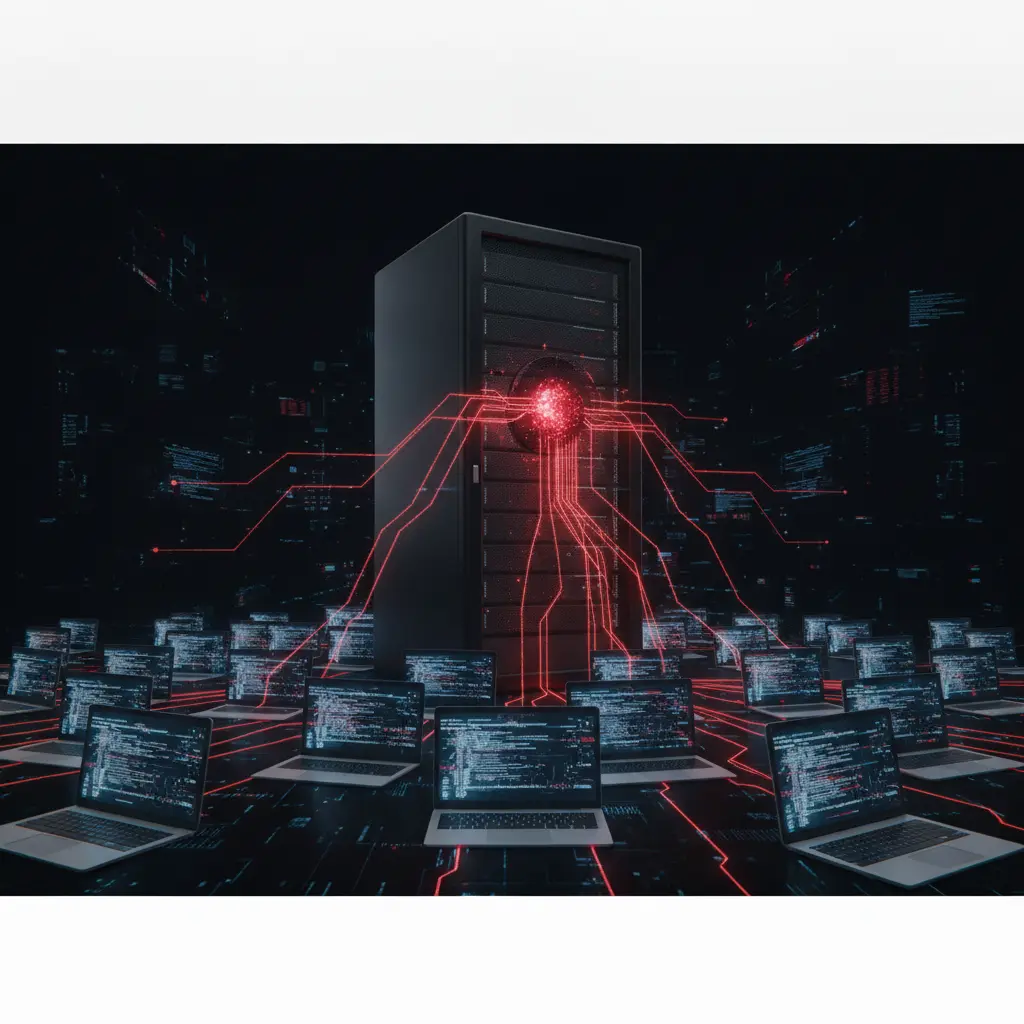
Your endpoint management server is no longer your security perimeter; under CVE-2026-35616, it is the adversary's automated deployment engine.
Beginning March 31, 2026, threat telemetry documented by vulnerability intelligence units at watchTowr and Defused recorded sustained, unauthenticated remote exploitation against internet-exposed Fortinet FortiClient Enterprise Management Server (EMS) instances. While initial field reports conflated the activity with an unrelated framework flaw tracked as CVE-2026-21873, Fortinet's formal advisory FG-IR-26-099 (opens in a new tab) confirmed the actual zero-day vector: an improper access control vulnerability (CWE-284) residing in the FortiClient EMS Web API. The flaw carries a CVSS v3.1 base score of 9.8 and impacts versions 7.4.5 through 7.4.6. Organizations that had rushed to deploy 7.4.5 to remediate the preceding SQL injection flaw, CVE-2026-21643 (FG-IR-25-1142), discovered they had navigated out of one perimeter breach directly into an unauthenticated remote execution vector.
Note what this means: enterprise security architecture still treats management appliances as trusted bastions, creating centralized kill switches where software vendors bundle orchestration privilege with internet-accessible web endpoints. The economic incentives of commercial IT demand centralized administrative convenience over network segregation. Because enterprise defenders routinely leave control-plane APIs exposed to public routing tables, a single API session validation failure converts thousands of compliant managed laptops into an instant botnet.
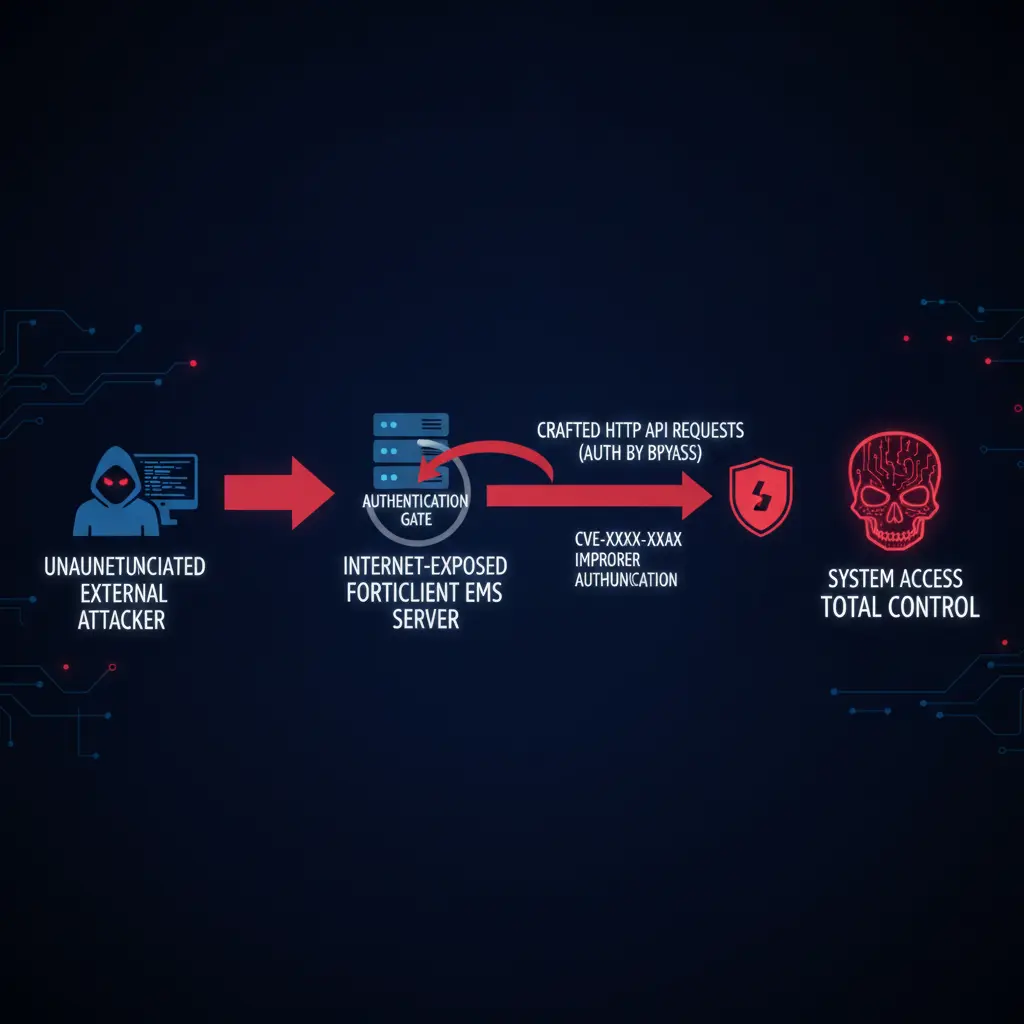
The Architecture of Ingress: Pre-Auth API Bypass
The root flaw inside FortiClient EMS versions 7.4.5 and 7.4.6 centers on improper session state handling across internal REST endpoints. Attackers target unauthenticated endpoints under the web services daemon, leveraging MITRE ATT&CK Technique T1190 (Exploit Public-Facing Application) (opens in a new tab) to bypass administrative authorization routines. Because the API layer fails to establish strict identity verification before delegating requests to back-end management modules, crafted HTTP requests execute with the operating system rights of the underlying EMS service account—typically NT AUTHORITY\SYSTEM on Windows deployments.
The human irony here is striking: network engineering teams diligently configured FortiClient to ensure every worker's device adhered to zero-trust compliance profiles, while exposing the single master control server to Shodan queries from any internet browser.
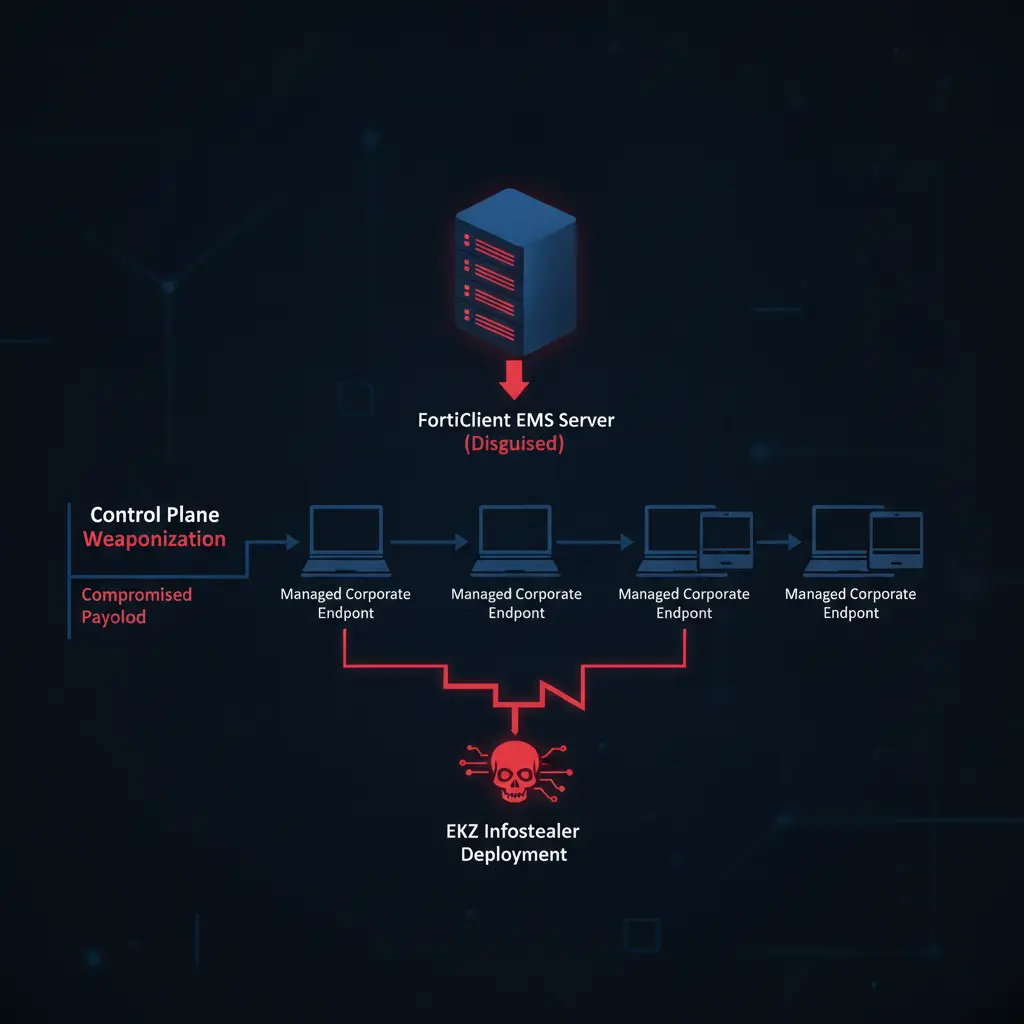
Control-Plane Weaponization: The EKZ Infostealer Campaign
Adversaries executing CVE-2026-35616 did not traverse enterprise internal networks via traditional SMB or WMI lateral movement. Instead, forensic analysis by incident responders at Arctic Wolf and eSentire shows attackers harnessed FortiClient EMS's native synchronization protocol. By instructing the central server to push operational packages to connected endpoints, adversaries turned legitimate management infrastructure into an automated distribution platform.
The payload delivered in observed intrusions is the EKZ Infostealer. Deployed via encoded PowerShell scripts (MITRE ATT&CK T1059.001) (opens in a new tab) masquerading as official Fortinet hotfix binaries, the malware initializes execution within user sessions. EKZ specifically hunts Credentials from Web Browsers (MITRE ATT&CK T1555.003) (opens in a new tab), bypassing DPAPI token protections in Chromium and Firefox profiles before establishing outbound Application Layer Protocol (MITRE ATT&CK T1071.001) (opens in a new tab) exfiltration tunnels back to attacker-operated infrastructure.
Following confirmed exploitation in multiple global environments, the Cybersecurity and Infrastructure Security Agency added CVE-2026-35616 to the CISA Known Exploited Vulnerabilities Catalog (opens in a new tab), mandating immediate federal remediation.
Proof of Concept
Defensive assessment requires validating whether exposed FortiClient EMS instances enforce API authentication boundaries without deploying destructive payloads. Security operations teams should execute this non-destructive auditing sequence to verify interface exposure and patch compliance.
Target Identification and Version Audit Identify if the EMS administrative gateway is reachable on the management port (default HTTPS 8013) and check the HTTP header disclosure.
bash curl -k -I https://ems-target.corp.internal:8013/Inspect the response headers for service banners indicating FortiClient EMS build levels. Builds prior to 7.4.7 or without hotfix patches 7.4.5.2111 / 7.4.6.2170 fall within the vulnerable scope.
Unauthenticated API Endpoint Assessment Issue a benign API query against the telemetry and client management routes to verify whether the access control gateway enforces authorization challenges.
bash curl -k -X POST https://ems-target.corp.internal:8013/api/v1/client/status \ -H "Content-Type: application/json" \ -d '{"client_id": "audit_probe"}'A patched or mitigated instance will strictly return an HTTP
401 Unauthorizedor403 Forbiddenstatus code. A vulnerable instance accepts the request state without authorization validation.Endpoint Process Hierarchy Hunting To verify if an EMS control plane has already been subverted into distributing secondary binaries, run this PowerShell telemetry audit on managed hosts:
bash Get-WinEvent -FilterHashtable @{LogName='Microsoft-Windows-Sysmon/Operational'; Id=1} | Where-Object { $_.Properties[21].Value -like '*FortiClient*' -and $_.Properties[4].Value -like '*powershell.exe*' }Any output indicates the FortiClient endpoint agent has initiated shell interpreters—a critical indicator of unauthorized policy execution.
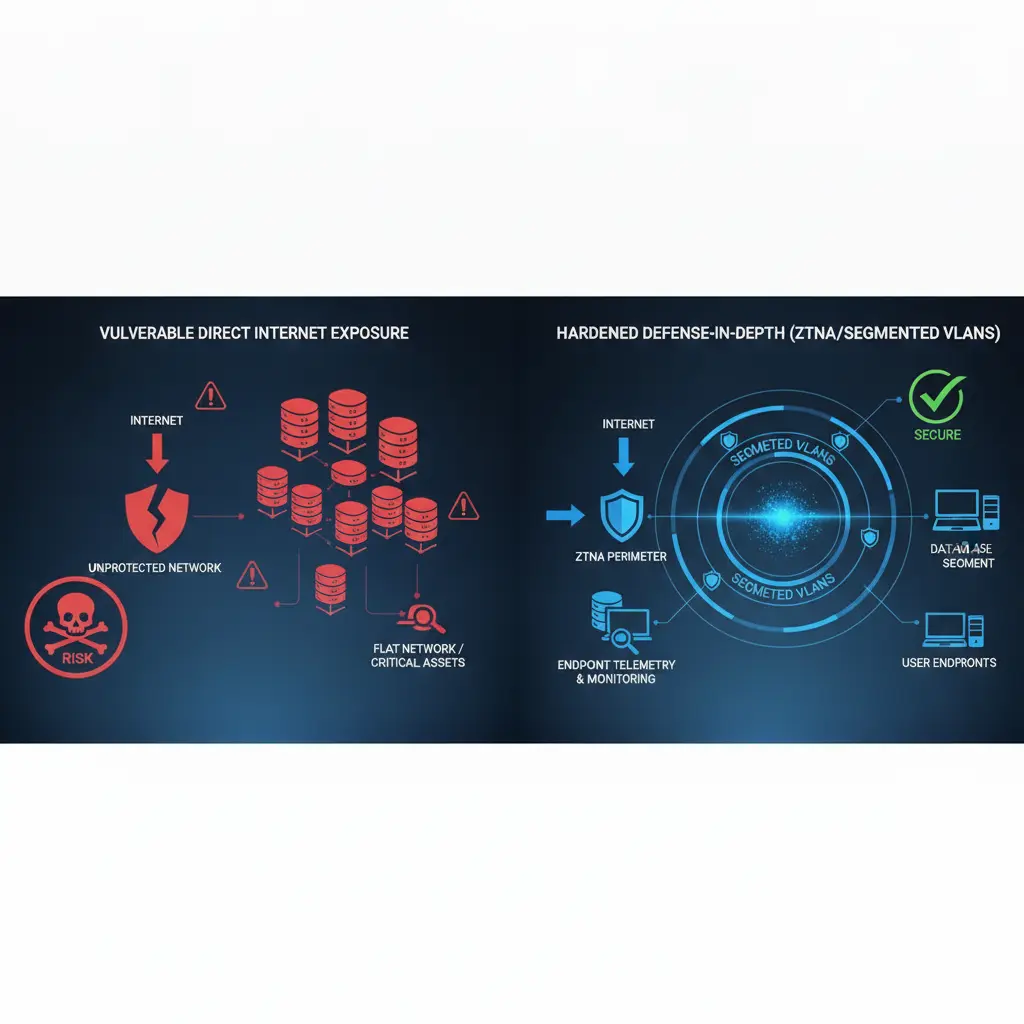
Remediation and Defensive Hardening
Organizations cannot treat this incident as routine patch maintenance. The convergence of pre-authentication RCE and central fleet control requires a structured response:
Patching & Hotfixes: Upgrade all on-premises FortiClient EMS instances to 7.4.7+. In environments requiring validation windows, deploy emergency hotfix build
7.4.5.2111or7.4.6.2170.Elimination of Public Ingress: Restrict ingress to TCP port 8013 and administrative portals via zero-trust network access (ZTNA), client-authenticated VPNs, or internal management subnets.
Threat Hunting for EKZ Indicators: Sweep enterprise endpoints for outbound HTTPS connections to unclassified external IP addresses originating from browser or temp directory execution paths.
FINAL VERDICT
The FortiClient EMS zero-day vulnerability (CVE-2026-35616) represents an acute operational risk created by centralizing endpoint authority on exposed perimeter servers. When enterprise management planes are left open to the public internet, organizations bear systemic liability for every compromised credential across their workforce. If your administrative console was directly accessible from the internet between March 31 and your patch deployment date, you must assume post-exploitation persistence and initiate compromise assessment immediately. Contact BreachModal's Adversarial Simulation and Incident Response teams to inspect your telemetry, isolate compromised nodes, and harden control-plane architecture.