
 BreachModal
- Published
- Under
- AI Security
- Reading time
- 6 min
PyPI Supply Chain Poisoning: Rust Stealers in Binary Wheels
Summary
Analysis of PyPI supply chain poisoning deploying compiled Rust stealers via typo-squatted wheels and .pth execution hooks. Mitigations, telemetry, and IOCs.

The developer workstation is no longer an engineering sandbox; it is the production network's softest underbelly, systematically targeted by PyPI supply chain poisoning campaigns. Modern software supply chain adversaries have abandoned crude, plaintext setup.py scripts in favor of compiled, high-performance implants hidden inside pre-built Python Wheels. By shifting delivery to binary distribution formats (.whl), threat actors bypass traditional static code linters and registry scanners to deploy evasion-hardened Rust information stealers directly into enterprise build pipelines.
Over the past two quarters, automated telemetry across open package repositories identified sustained campaigns attributed to clusters including the IronWorm syndicates, Hades operators, and remnants of the W4SP copycat networks. Rather than publishing source distributions that trigger inspection during package compilation, these groups upload typo-squatted wheels targeting core utilities such as litellm, requests, and colorama. Because these payloads contain malicious intent from inception rather than software defects, they evade traditional CVE issuance and are tracked under <a href="github.com/ossf/malicious-packages (opens in a new tab)">OpenSSF Malicious Packages Repository</a> records such as MAL-2024-1182 and MAL-2026-0043. When packaging machinery does fail to isolate archive structures, critical identifiers like <a href="nvd.nist.gov/vuln/detail/CVE-2025-13327 (opens in a new tab)">CVE-2025-13327</a> emerge, exposing how package managers parse malformed archives.
Note what this means: your software supply chain security model assumes that dependency installation is an inert, deterministic action. That assumption is mathematically broken. The economics of package registry governance favor zero-friction publishing over mandatory cryptographic verification, shifting the entire defensive burden onto downstream consumers who lack the binary analysis tooling required to audit compiled wheels.
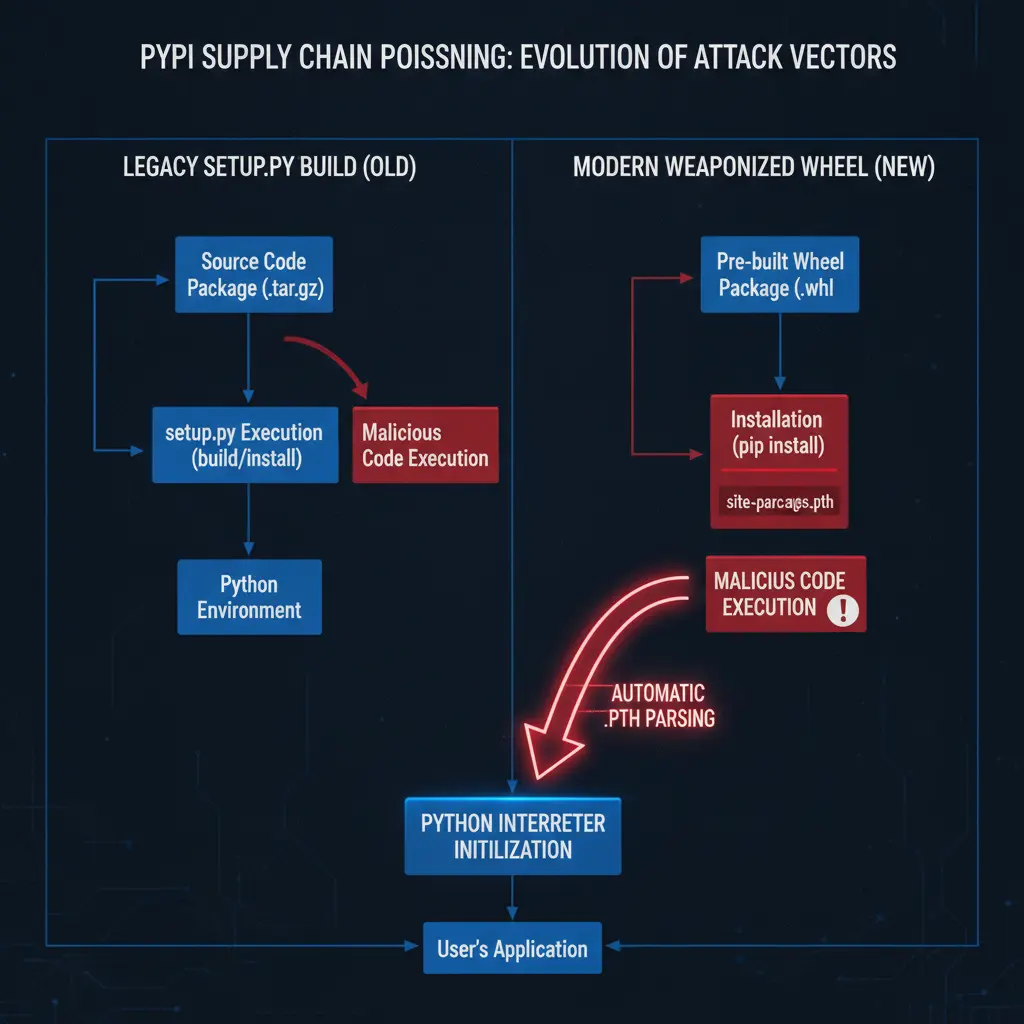
Anatomy of Typo-Squatted Wheels in PyPI Supply Chain Poisoning
Adversaries exploit two parallel vectors during package resolution: classical typo-squatting and modern generative AI 'slopsquatting.' The former targets human typographical slips—transposing characters, substituting underscores with hyphens, or leveraging visual homoglyphs. The latter exploits non-deterministic code completion engines in IDEs that hallucinate non-existent package names, which attackers continuously pre-register on public indexes according to <a href="attack.mitre.org/techniques/T1195/001/ (opens in a new tab)">MITRE ATT&CK Technique T1195.001 (Supply Chain Compromise)</a>.
Historically, security tooling looked for arbitrary code execution in setup.py during the sdist build phase. Binary Wheels (.whl) render that defense obsolete. A Wheel is simply a ZIP archive unpacked directly into Python's site-packages folder, executing zero package-author setup logic during pip install.
To achieve execution without relying on setup.py or waiting for a user to explicitly import the module, operators abuse Python path configuration (.pth) files or malicious sitecustomize.py modules as defined in <a href="attack.mitre.org/techniques/T1574/006/ (opens in a new tab)">MITRE ATT&CK Technique T1574.006 (Dynamic Linker Hijacking)</a>. Under Python core interpreter mechanics, any .pth file located within site-packages is parsed on interpreter initialization; any line beginning with 'import ' is evaluated immediately. As Graham Cluley might observe, developers spend thousands of hours configuring enterprise endpoint detection, only to be compromised because Python thoughtfully decided to treat every configuration file in site-packages like an eager executive assistant opening untrusted mail.
Multi-Stage Staging and Native Extension Execution Hooks
The infection lifecycle operates as a disciplined, three-stage cascade designed to defeat automated sandbox heuristics and egress monitors:
Stage 1 (Persistence & Initialization): The interpreter loads the dropped .pth file or native compiled shared library (.abi3.so on Linux/macOS or .pyd on Windows). The loader tests for sandbox indicators (debugging flags, virtual machine hypervisor artifacts, execution time skew).
Stage 2 (Encrypted Stager Dropper): The initial hook queries a secondary C2 node or decodes a high-entropy binary blob embedded within innocent-looking image assets shipped in the wheel archive. This bypasses naive network perimeter inspections.
Stage 3 (Native Rust Stealer Execution): The dropper launches an OS-specific, stripped Rust binary detached from the primary Python process tree as documented under <a href="attack.mitre.org/techniques/T1059/006/ (opens in a new tab)">MITRE ATT&CK Technique T1059.006</a>.
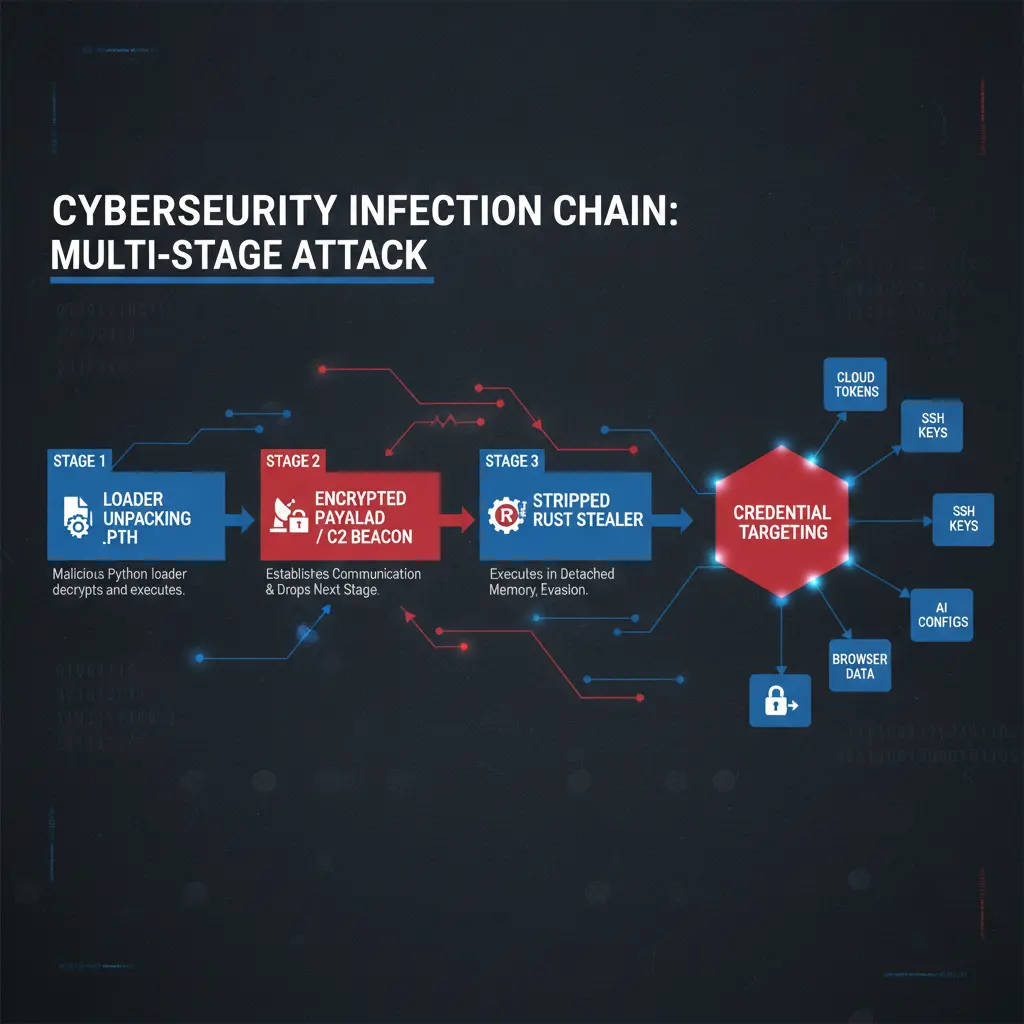
If you were the CISO reviewing forensic snapshots during such an intrusion, you would not see a conspicuous bash shell or suspicious PowerShell loop. You would see an orphaned, stripped ELF or PE process silently reading developer dotfiles with standard user permissions.
Technical Deep Dive: Why Attackers Choose Rust for Pipeline Espionage
The migration from obfuscated Python scripts to compiled Rust executables represents an engineering optimization by crimeware developers. Stripped, statically linked Rust binaries present intricate control flow graphs that degrade standard heuristic signatures used by legacy Endpoint Detection and Response (EDR) platforms. Furthermore, Rust's zero-cost cross-compilation pipeline allows operators to target Linux CI/CD runners, macOS M-series developer laptops, and Windows enterprise workstations from a single unified codebase.
Once resident in memory, the Rust stealer initiates targeted harvesting mapped to <a href="attack.mitre.org/techniques/T1552/001/ (opens in a new tab)">MITRE ATT&CK Technique T1552.001 (Credentials in Files)</a>. The stealer sweeps standard developer paths, extracting high-value targets within seconds:
Cloud Identities: AWS credentials (~/.aws/credentials), Google Cloud SDK session tokens, Azure CLI access profiles, and Kubernetes configurations (~/.kube/config).
Developer Vaults: Environment files (.env), SSH private keys (~/.ssh/id_*), unencrypted Git credentials, and active GitHub Enterprise session tokens.
Registry Publishing Secrets: Stored PyPI API tokens (~/.pypirc), npm authentication tokens (~/.npmrc), and container registry configurations (~/.docker/config.json).
AI Agent Frameworks: Claude Code session tokens (~/.claude.json), OpenAI and Anthropic API keys, and local Cursor IDE assistant preferences.
Exfiltration occurs over TLS 1.3 encrypted HTTP POST requests to ephemeral C2 relays, Discord webhooks, or abuse of automated private GitHub repository creation using the developer's newly stolen personal access tokens.
Proof of Concept: Simulating .pth Execution Mechanics and Package Auditing
To audit whether your CI/CD environments and developer endpoints are susceptible to unimported startup code execution, the following verification model demonstrates how the Python interpreter processes configuration directives in site-packages and how security teams can statically intercept them.
1. Environment Setup: Creating an Isolated Inspection Workspace Establish an isolated virtual environment to simulate how package managers unpack binary distributions:
python3 -m venv /tmp/audit_env
source /tmp/audit_env/bin/activate
mkdir -p /tmp/audit_env/lib/python$(python3 -c 'import sys; print(f"{sys.version_info.major}.{sys.version_info.minor}")')/site-packages
2. Simulating the Execution Hook Simulate an audit canary by injecting a non-destructive runtime assertion into a synthetic configuration file within the environment's site-packages:
cat << 'EOF' > /tmp/audit_env/lib/python$(python3 -c 'import sys; print(f"{sys.version_info.major}.{sys.version_info.minor}")')/site-packages/security_audit_hook.pth
import sys; sys.stderr.write("[BREACHMODAL AUDIT] Warning: Unsolicited site-packages startup execution detected via .pth hook.\n")
EOF
3. Demonstrating Pre-Import Code Trigger Execute a benign Python invocation. Notice that code executes before user code or application entrypoints run:
python3 -c "print('Application execution starts here.')"Expected Output:
[BREACHMODAL AUDIT] Warning: Unsolicited site-packages startup execution detected via .pth hook.
Application execution starts here.
4. Static Binary Wheel Inspection Rule Implement an automated build gate using Python to extract and audit wheels for stealth execution files before allowing pip to unpack them:
import zipfile
import sys

def audit_wheel(wheel_path):
    suspicious_patterns = ['.pth', 'sitecustomize.py', 'usercustomize.py', '.so', '.pyd', '.dylib']
    with zipfile.ZipFile(wheel_path, 'r') as archive:
        for file_info in archive.infolist():
            for pattern in suspicious_patterns:
                if file_info.filename.endswith(pattern):
                    print(f"[ALERT] High-Risk Artifact Detected: {file_info.filename}")
                    return False
    print("[PASS] No immediate startup hooks or unverified binary extensions detected.")
    return True

if __name__ == '__main__':
    if len(sys.argv) > 1:
sys.exit(0 if audit_wheel(sys.argv[1]) else 1)Mitigation Architecture and Defensive Controls
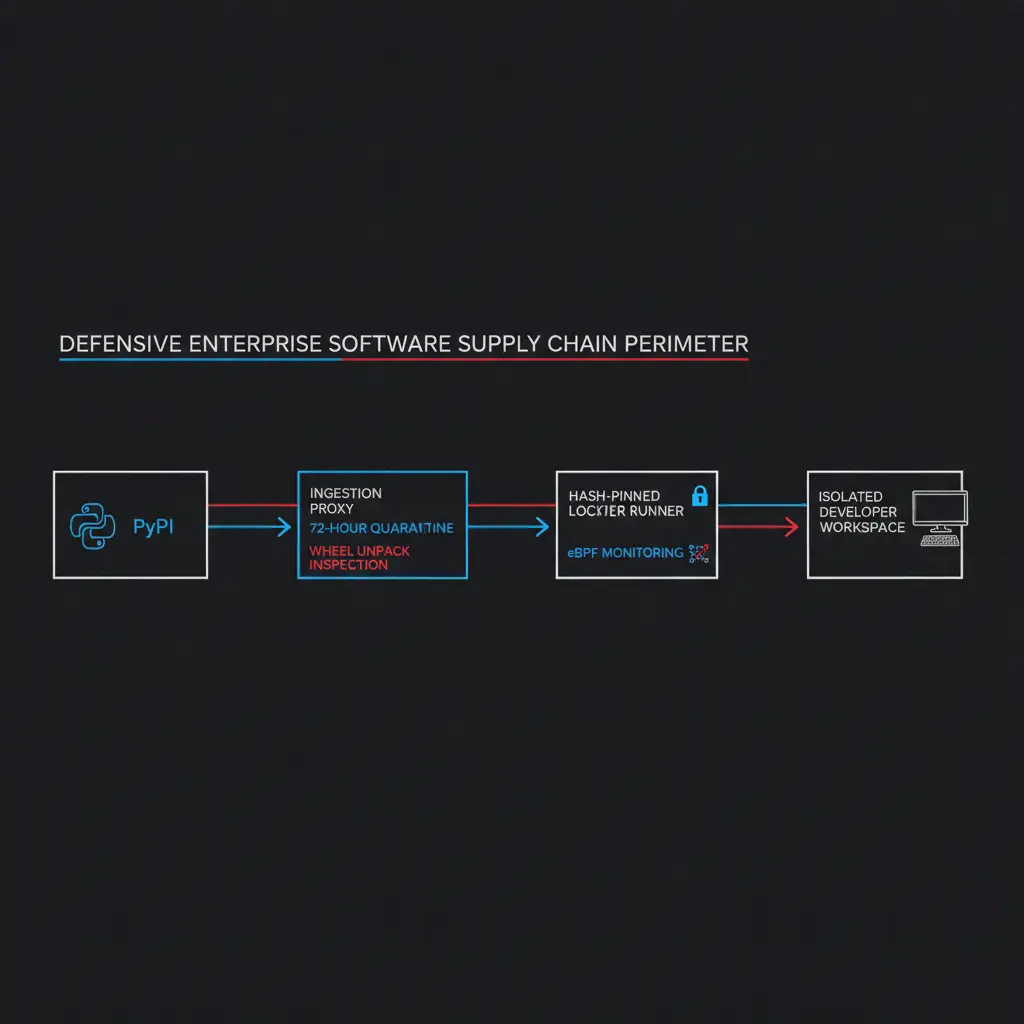
Remediating PyPI supply chain poisoning requires shifting from passive vulnerability alerts to deterministic installation controls and continuous binary validation:
Enforce Cryptographic Hash Pinning: Eliminate floating dependency requirements. Mandate lockfiles generated with full cryptographic hash verification (pip install --require-hashes -r requirements.txt, poetry.lock, or uv.lock). Threat actors uploading malicious replacement wheels cannot forge upstream sha256 checksums.
Binary Inspection in CI Artifact Caches: Integrate deep inspection on all cached wheels before ingestion into private package mirrors (such as Artifactory or Nexus). Disallow wheels containing native extensions (.so, .pyd) unless compiled by approved, internally verified pipelines.
Registry Ingestion Age-Gating: Enforce proxy rules quarantining packages published to PyPI within the last 72 hours. The vast majority of malicious typo-squatted packages are triaged and purged by community intelligence within the first 48 hours.
Ephemeral Build Workloads and Short-Lived OIDC: Decommission permanent static cloud credentials on build nodes. Implement OpenID Connect (OIDC) federated identities across CI runners, ensuring that any environment variables harvested by Rust stealers expire within minutes.
Monitor Interpreter File Operations: Deploy auditd, eBPF probes, or endpoint telemetry to monitor anomalous file writes into global and virtual environment site-packages paths, triggering high-severity alerts on any unexpected .pth file creation.
FINAL VERDICT
PyPI supply chain poisoning utilizing typo-squatted wheels and multi-stage Rust stealers has elevated dependency risks from a software hygiene issue to an existential corporate authentication crisis. The threat cannot be solved by developer awareness seminars or post-facto CVE alerting, especially when malicious packages bypass standard vulnerability registries entirely. The risk falls directly on engineering leaders whose architectures permit unverified third-party binaries to execute with root or developer privileges. Organizations that continue to run unpinned, unauthenticated pip installations are operating on borrowed time. Schedule an Adversarial Supply Chain Simulation with BreachModal to quantify your build pipeline's exposure before your credentials populate adversary leak sites.